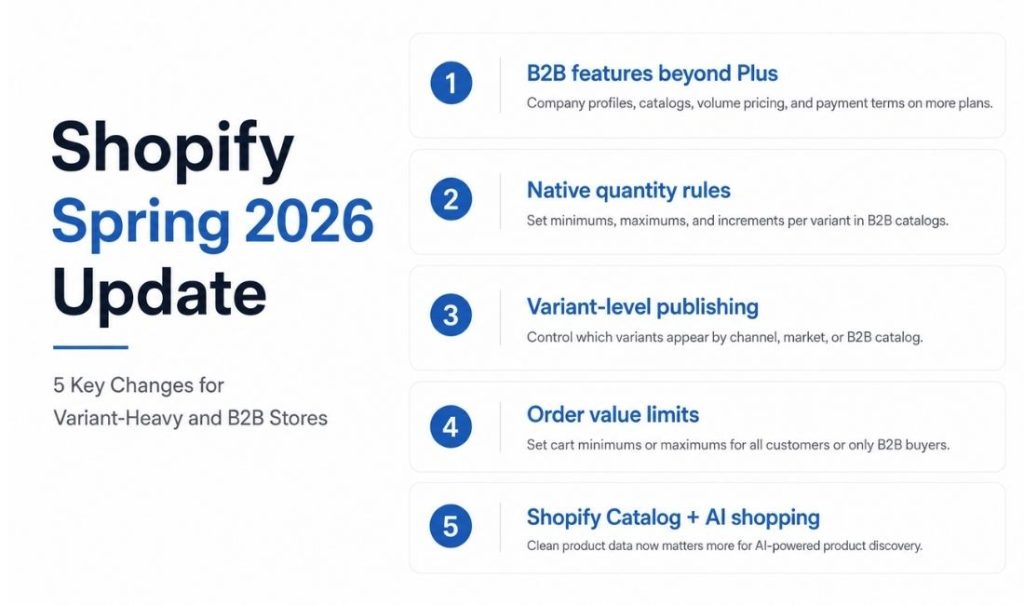
If you’ve been hearing about the Shopify Spring 2026 update and wondering whether any of it matters for your store, the short answer is: it depends on what you sell and how you sell it. For stores running lots of product variants, serving wholesale buyers, or both, five specific changes from this spring are worth understanding. Shopify expanded B2B features to more plans, made native quantity rules available to more merchants, introduced variant-level publishing, opened order value limits beyond Plus, and launched Shopify Catalog for AI shopping channel distribution. This piece covers what each one does, who it’s actually for, and where the edges still are.
- Shopify’s spring 2026 update expanded B2B features, including company profiles, volume pricing, and up to three B2B catalogs, to Basic, Grow, and Advanced plans at no extra cost.
- Native B2B quantity rules covering minimums, maximums, and increments per variant are now accessible on more plans, but they apply to B2B company profiles only, not retail customers.
- Variant-level publishing lets merchants control which variants are active on which sales channels and markets without workarounds or third-party apps.
- Order value limits via Checkout Blocks expanded beyond Shopify Plus to Basic, Grow, and Advanced plans as of April 2026, but still have no product-level or collection-level scoping.
- Shopify Catalog now automatically structures and syndicates your product data to AI shopping channels; clean, complete variant data determines whether your products actually show up.
Table of Contents
What Changed With Shopify B2B Features
For a long time, getting serious about wholesale on Shopify meant one thing: upgrading to Shopify Plus. Company profiles, custom catalogs with tailored pricing, volume discounts, and payment terms were all locked behind the Plus tier. The Shopify Spring 2026 Editions changed that.
Here’s what’s now available on Basic, Grow, and Advanced plans at no extra cost:
- Company profiles: Set up dedicated accounts for wholesale buyers, separate from your retail customer base.
- Custom B2B catalogs: Create up to three catalogs with tailored pricing per wholesale account or segment.
- Volume pricing: Offer quantity-based price breaks directly inside a B2B catalog.
- Payment terms: Let wholesale buyers pay on net terms rather than requiring upfront payment at checkout.
Merchants who have been managing wholesale buyers through locked pages, manual invoices, spreadsheets, or third-party pricing apps now have access to native Shopify B2B features inside the same admin they already use for retail.
What it doesn’t change: Shopify Plus still holds the scale advantages. Here’s what stays Plus-only:
- Catalog volume: Non-Plus plans are capped at three B2B catalogs total.
- Partial payments and deposits: Collecting a deposit at order and the balance at fulfillment remains a Plus-exclusive feature.
- Sales rep permission scoping: Assigning a staff member to manage only specific company accounts is not available on non-Plus plans.
This is an access change, not a feature change. The Shopify B2B features themselves aren’t new; what’s new is who can use them without a Plus subscription.
What Changed With Native Quantity Rules
Alongside the broader B2B expansion, native B2B quantity rules are now accessible on more plans. These live inside B2B catalogs in Shopify Markets and give wholesale merchants real order structure at the variant level.
Here’s what native quantity rules now support:
- Minimum order quantities: Require a wholesale buyer to order at least a set number of units of a specific variant before checkout proceeds.
- Maximum order quantities: Cap how many units a buyer can order per variant in a single transaction.
- Increment rules: Force orders in defined multiples per variant, so a buyer can order 6, 12, or 18 units but not 7 or 11.
For merchants who have been using workarounds to enforce order minimums with trade customers, this is a meaningful native option. The setup lives inside Markets, under your B2B catalog configuration.
Two things to understand clearly about what these rules don’t cover:
- Retail customers are excluded: Native B2B quantity rules apply to customers assigned to a B2B company profile only. Standard retail customers browsing your storefront are not affected.
- No mix-and-match logic across variants: If a buyer needs to order a combined quantity across multiple sizes or colors of the same product, Shopify’s native rules handle each variant independently. For stores that need cross-variant combined quantity logic, whether for retail or B2B, an app like MultiVariants is built specifically for that use case.
Native B2B quantity rules work well for straightforward wholesale minimums assigned to company profiles. Outside that scope, the native options run out quickly.
What Changed With Variant-Level Publishing
Before the Shopify Spring 2026 update, publishing control lived at the product level. If you wanted a product on your retail storefront but not in your B2B catalog, or available in one market but not another, you were working around the platform, creating duplicate products, hiding variants manually, or using apps to approximate the control you needed.
Variant-level publishing changes that. Here’s what’s now possible:
- Per-channel control: Activate or deactivate individual variants on specific sales channels without affecting how the product appears elsewhere.
- Per-market control: Publish or unpublish individual variants by sales channel or catalog, including B2B catalog use cases.
- Simultaneous multi-channel presence: A single product can appear in your retail online store, your B2B catalog, and a regional market at the same time, with different variants active in each.
For B2B stores running retail and wholesale from the same Shopify store, this is a real operational simplification. You no longer need separate product setups to control what your wholesale buyers see versus what retail customers see at the variant level.
One thing this feature doesn’t fix on its own:
- Clean variant structure is still your responsibility: Inconsistent variant naming, duplicated options, or messy attribute setups create problems that variant-level publishing surfaces rather than solves. If your catalog is structured cleanly, this feature gives you precise control. If it isn’t, that’s the work to do first.
What Changed With Order Value Limits
Order value limits, the ability to set a minimum or maximum subtotal that a cart must meet before checkout can proceed, were previously available only to Shopify Plus merchants through Checkout Blocks. As of April 13, 2026, that changed. Here’s what’s now available on Basic, Grow, and Advanced plans:
- Cart minimum enforcement: Require a minimum subtotal before a customer can complete checkout, useful for B2B stores with minimum order value policies.
- Cart maximum enforcement: Set a ceiling on cart subtotals, applicable to all customers or scoped to B2B company accounts only.
- Pre-gift card calculation: Limits are calculated on the subtotal before gift cards and store credit are applied.
- Customer scoping: Apply the rule to all customers or restrict it to B2B company profiles only.
What order value limits still don’t support:
- No product-level scoping: You can’t set a minimum that applies only when a customer is buying from a specific product or collection. The rule applies to the cart as a whole.
- No collection-level scoping: Different minimums per product category are not supported natively.
It’s also worth understanding the actual technical limitation accurately. Shopify’s validation function API supports up to 25 active functions, so the ceiling isn’t a single store-wide rule. The real constraint is the lack of granular scoping, not a hard cap on how many rules you can run.
What Changed With Shopify Catalog and AI Shopping
The most talked-about part of the Shopify Spring 2026 Editions is also the one with the longest runway before most merchants feel its full effect. Shopify Catalog is Shopify’s infrastructure for syndicating your product data to AI shopping channels. Here’s what changed and what it includes:
- Automatic syndication: Merchants on eligible plans are included in Shopify Catalog by default, with product data distributed to AI channels including ChatGPT, Microsoft Copilot, and the Shop app, no separate setup or feed required.
- Structured data distribution: Catalog formats your product information so AI shopping assistants can read, understand, and surface it accurately.
- Personalized results for signed-in shoppers: The Catalog API now supports sign-in with Shop, so shoppers who are signed in see results that reflect their purchase history.
For variant-heavy stores, the practical implication is specific. AI shopping channels read your product data directly. When a shopper asks an AI assistant to find a specific variant, what comes back depends entirely on what’s in your catalog:
- Complete titles and variant names help AI channels match the right product to the right search.
- Filled metafields and structured attributes allow assistants to filter and recommend accurately at the variant level.
- Thin or ambiguous descriptions mean products either don’t surface or surface with inaccurate information.
Shopify B2B features and Catalog work together here too. Structured B2B catalog data that’s clean and complete positions your products accurately across every surface Catalog reaches. This isn’t a set-and-forget update. Shopify Catalog distributes whatever data you’ve already built. The spring 2026 update opened the channel; the data work is still yours to do.
What These Five Shopify Spring 2026 Updates Look Like Together
Taken individually, each of these five updates from the Shopify Spring 2026 update addresses a specific gap. Taken together, they form a more coherent picture of where Shopify is moving for variant-heavy and B2B stores.
B2B on more plans removes the access barrier to wholesale tooling. Native quantity rules give structure to how wholesale buyers order. Variant-level publishing gives channel-level control over what each buyer type sees. Order value limits give checkout-level guardrails for cart minimums and maximums. Shopify Catalog gives your product data a distribution path into AI shopping channels.
The thread connecting all five is product and catalog data. Every one of these updates works better when your variant structure is clean, your attributes are complete, and your catalog is organized deliberately. B2B catalogs with inconsistent pricing tiers, variant-level publishing applied to messy product setups, and Catalog syndicating incomplete data all produce worse outcomes than the features themselves are capable of delivering.
The Shopify Spring 2026 Editions moved the platform meaningfully forward for this merchant type. Native tools now cover ground that previously required workarounds or third-party apps for many use cases. Where gaps remain, they’re specific: no cross-variant mix-and-match quantity logic natively, no product or collection-level scoping for order value limits, and no substitute for doing the catalog data work yourself. Those are documented, bounded gaps, not reasons to dismiss what changed.
Shopify Spring 2026 Editions: FAQ
Do I need Shopify Plus to use B2B features after the Shopify Spring 2026 update?
No. As of spring 2026, foundational Shopify B2B features including company profiles, volume pricing, and up to three B2B catalogs are available on Basic, Grow, and Advanced plans at no extra cost. Shopify Plus still covers higher-scale needs like unlimited catalogs, partial payments, and sales rep permission scoping by company account.
Can Shopify’s native quantity rules apply to retail customers, not just B2B buyers?
Native B2B quantity rules apply only to customers assigned to a B2B company profile. They don’t apply to standard retail customers browsing your online store. If you need quantity rules for retail buyers or combined quantity logic across variants, the native feature doesn’t cover that scope.
What does variant-level publishing actually do that wasn’t possible before?
Before spring 2026, publishing control applied at the product level only. Variant-level publishing lets you activate or deactivate individual variants per sales channel and per market, so a product can appear across retail, B2B, and regional channels simultaneously with different variants active in each.
What is the real limitation of order value limits in Checkout Blocks?
The limitation is scope, not a hard single-rule cap. Order value limits apply to the cart as a whole; there’s no product-level or collection-level scoping. Shopify’s validation function API supports up to 25 active functions, so running multiple rules isn’t the constraint; targeting them to specific products or collections is what the native feature doesn’t support.
Does Shopify Catalog automatically improve how my products show up in AI search?
Shopify Catalog syndicates your existing product data to AI shopping channels automatically, but the quality of what gets distributed depends on the quality of your data. Complete titles, structured variant names, and filled metafields improve how accurately AI channels surface your products. The channel is open by default; the data work is still yours.
Conclusion
The Shopify Spring 2026 update brought five concrete changes that matter for a specific type of merchant: stores managing large variant catalogs, serving wholesale buyers alongside retail customers, or both. Shopify B2B features are now accessible on more plans, which removes a real barrier for merchants who have been handling wholesale manually. Native quantity rules add structure for B2B order minimums at the variant level. Variant-level publishing gives channel-by-channel control without workarounds. Order value limits now work beyond Plus for stores that need cart minimums or maximums at checkout. And Shopify Catalog opens a distribution path into AI shopping channels for merchants whose product data is clean enough to benefit from it.
Where the native tools still have edges, those edges are specific. Mix-and-match quantity logic across variants, product-level or collection-level order value scoping, and the ongoing work of maintaining clean catalog data are all still outside what the Shopify Spring 2026 Editions resolve natively. Knowing exactly where native stops is as useful as knowing what’s new.

Syeda Rehnoma Tanzom
This article was reviewed by the MultiVariants Technical Support Team, who regularly helps Shopify merchants test bulk ordering setup, variant selection, quantity rules, cart behavior, and checkout validation issues.