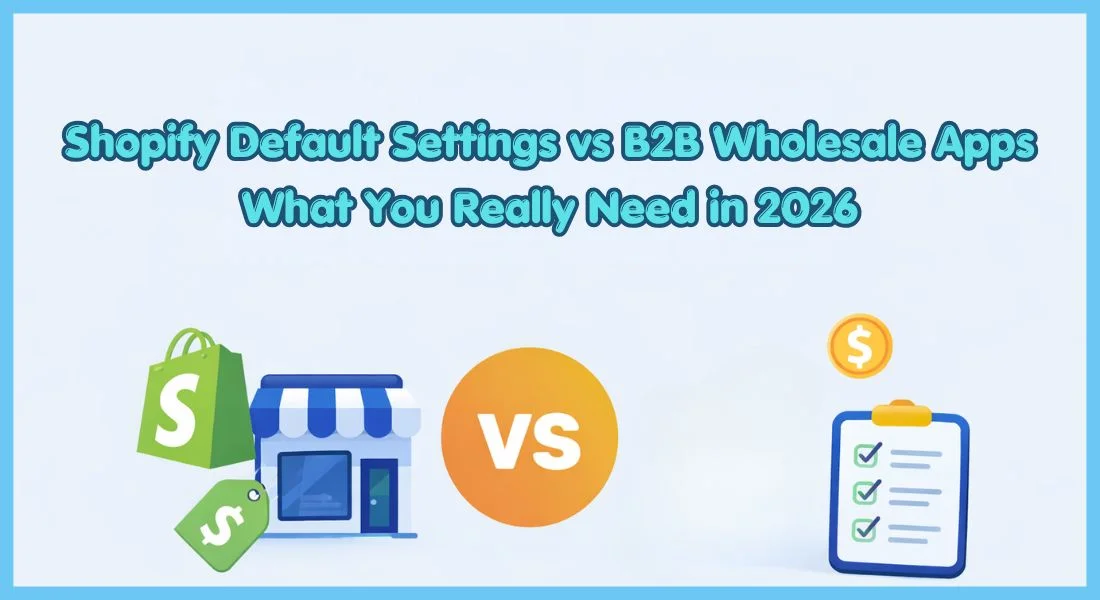
The Shopify Default Settings Vs B2B Wholesale App debate just got more interesting. On April 2, 2026, Shopify expanded native B2B features to all plans, including Basic. Company profiles, volume pricing, and payment terms. Features that used to require Shopify Plus are now available to everyone.
But here is the thing. Gaps still exist. Real ones. And for merchants serious about wholesale, those gaps matter.
Here is why this matters right now: CapitalOneShopping reports that the global B2B ecommerce market is valued at $32.1 trillion in 2025 and is on track to hit $36 trillion by 2026, growing at a 14.5% CAGR. And 80% of B2B sales interactions now happen digitally. If your store is not built for that, you are losing sales.
This guide breaks down exactly what Shopify’s defaults now offer, where they still fall short, and when a B2B wholesale app becomes essential.
- Shopify now includes basic B2B features like company profiles, volume pricing, and payment terms on all plans.
- But bulk ordering, approval flows, MOQ rules, and automation are still missing from Shopify’s default setup.
- Shopify Plus adds advanced features, but it is expensive and not needed for most growing wholesale businesses.
- B2B wholesale apps fill these gaps with bulk ordering, flexible pricing, automation, and better buying experience.
- The best approach is combining Shopify’s native features with a B2B app to scale wholesale effectively.
What Shopify’s Default Settings Now Offer
When we are comparing Shopify Default Settings Vs B2B Wholesale App, we need to first talk about the platform’s default settings. Shopify has made significant progress in 2026. As of April 2, 2026, the following B2B features are available natively on Basic, Grow, and Advanced plans at no extra cost:
- Company profiles – set up and manage wholesale buyer accounts
- Volume pricing – offer quantity-based price breaks natively
- Payment terms – net payment options for B2B buyers
- Up to 3 active B2B catalogs – assigned via Shopify Markets
- ACH payments – U.S. merchants only
- Vaulted credit cards – for repeat wholesale buyers
This is good news for merchants who are just getting started with wholesale or managing a few B2B accounts.
These native features are helpful. But they are not enough once your wholesale operation starts to grow.
What is Still Shopify Plus-Only
The advanced features remain locked behind Shopify Plus (from ~$2,300/month):
- Unlimited catalogs for customer-specific pricing
- Direct catalog assignment to specific companies and locations
- Partial payments and deposits at checkout
- Dedicated B2B checkout with full customisation
So, the question of Shopify Default Settings Vs B2B Wholesale App has not gone away. It has just shifted. The real gap now is not basic pricing. It is scale, automation, and the buying experience.
Where Shopify Defaults Still Fall Short
1. No Bulk Order Forms
Wholesale buyers do not shop like retail customers. They need to select multiple variants, enter large quantities, and see pricing updates instantly.
In the comparison of Shopify Default Settings Vs B2B Wholesale App, the first thing you will notice is that Shopify has no native bulk order form on any plan. B2B wholesale apps solve this with quick order forms. It is clean, fast, and professional. This alone is a reason most wholesale merchants turn to apps.
2. No Wholesale Registration or Approval Flow
If you want to restrict access to your wholesale pricing (and you should), Shopify’s defaults do not offer a built-in registration or approval system.
B2B wholesale apps handle this end-to-end. Customers apply, you approve, they get access automatically. Retail shoppers never see your wholesale prices.
3. No Minimum Order Quantity (MOQ) Enforcement
Shopify does not natively enforce minimum order quantities at checkout on any plan.
This is critical for wholesale. Without MOQs, your bulk pricing stops making financial sense. B2B apps let you set minimum quantities per product or per order, and block checkout if the requirement is not met.
4. Limited Catalog Flexibility Without Plus
Non-Plus plans are limited to 3 active B2B catalogs. That sounds like enough until you have more than 3 customer segments needing different pricing.
A B2B wholesale app removes this flaw entirely. You can create unlimited pricing rules, customer groups, and discount tiers without upgrading to Plus.
5. No Advanced Automation
In B2B, manual work kills efficiency. Approving orders, triggering discount rules, and managing customer tiers. It all adds up fast.
Shopify’s defaults, even with the new features, do not automate much of this. B2B apps do. Discounts apply automatically. Registration workflows run without you. That saved time proves to be very helpful as you scale.
6. Shipping Still Needs Manual Setup
Shopify does support custom shipping profiles natively, but configuring different rates per wholesale customer group still requires manual work and does not adapt automatically.
B2B wholesale apps let you set shipping rules per customer group automatically. No manual intervention is needed each time.
Shopify Default Settings Vs B2B Wholesale App: The Comparison Table
| Feature | Shopify Defaults (All Plans) | Shopify Plus | B2B Wholesale App |
| Company profiles | ✅ Up to basic | ✅ Advanced | ✅ |
| Volume / tiered pricing | ✅ Up to 3 catalogs | ✅ Unlimited | ✅ Unlimited |
| Payment terms | ✅ | ✅ | ✅ |
| Bulk order forms | ✗ | ✗ | ✅ |
| Wholesale registration flow | ✗ | ✗ | ✅ |
| MOQ enforcement | ✗ | ✗ | ✅ |
| Unlimited customer pricing tiers | ✗ | ✅ | ✅ |
| Partial payments & deposits | ✗ | ✅ | Some apps |
| Automated discount rules | ✗ | Limited | ✅ |
| Direct catalog per company | ✗ | ✅ | ✅ |
Do You Still Need a B2B Wholesale App?
Yes, for most merchants, the answer is still yes. Here is why.
Shopify’s new native features are a solid starting point. But they are exactly that, a starting point. The Shopify Default Settings Vs B2B Wholesale App gap has narrowed on the pricing side. It still exists on everything else.
If you have more than 3 customer groups needing different pricing, you need an app. If you want a professional bulk ordering experience, you need an app. If you want wholesale registration and approval handled automatically, you need an app.
And the good news? Apps typically cost $20 – $100/month. That is a fraction of what Shopify Plus costs. For most growing wholesale businesses, it is the smarter move.
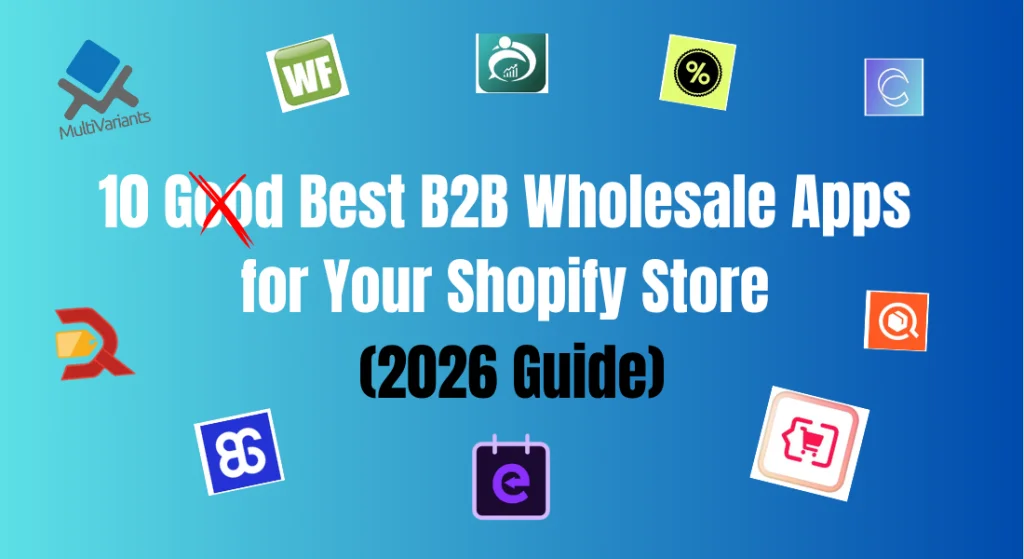
Looking for the right tools? Check out our in-depth guide to the best B2B wholesale apps for Shopify, covering features, pricing, and which apps suit different types of wholesale operations.
Why This Comparison Still Matters
Here is the core truth of the Shopify Default Settings Vs B2B Wholesale App conversation: Shopify’s defaults are getting better. But they are still not enough for serious wholesale.
The most successful merchants driving sales are not relying on defaults alone. They are using the right combination of native features and purpose-built apps to deliver a buying experience that wholesale customers actually expect.
That combination, not defaults alone, is what separates a store that processes the odd B2B order from one that is built to scale wholesale.
Final Thoughts
The Shopify Default Settings Vs B2B Wholesale App debate has a clearer answer in 2026 than it did a year ago. Shopify has genuinely improved its native B2B offering. Company profiles, volume pricing, and payment terms are now available on all plans. That is real progress.
But wholesale is more than pricing. It is bulk ordering. It is the registration flows. It is the MOQs. It is automation. None of that comes out of the box on any Shopify plan. A B2B wholesale app fills those gaps. It turns a capable store into one that wholesale buyers actually enjoy using. And in a market heading toward $36 trillion by 2026, that experience is what wins the sale.
FAQs
1. What is the main difference between Shopify Default Settings Vs B2B Wholesale App in 2026?
As of April 2026, Shopify includes basic B2B features like company profiles, volume pricing, and payment terms on all plans. But bulk order forms, registration approval, MOQ rules, and automation still need a B2B app. Defaults are a starting point. But apps make a store truly wholesale-ready.
2. Does Shopify now support B2B on all plans without an app?
Partially. Shopify now offers company profiles, 3 catalogs, volume pricing, payment terms, and ACH payments on Basic, Grow, and Advanced plans. But unlimited catalogs, direct assignment, deposits, and partial payments are still Plus-only. Bulk ordering and MOQ still require apps.
3. Do I still need Shopify Plus for B2B wholesale?
Not always. Non-Plus plans now include core B2B features. You need Plus for unlimited catalogs, direct catalog assignment, deposits, or partial payments. For most growing stores, a standard plan plus a B2B app is still more cost-effective.
4. Can I sell to both retail and wholesale customers from the same Shopify store?
Yes. Shopify supports both in one store. Retail customers see regular prices. Wholesale buyers log in to see custom pricing, catalogs, and bulk ordering tools on the same storefront.
5. Does Shopify support minimum order quantities (MOQs) natively?
No. Shopify does not support MOQ on any plan. You need a B2B wholesale app like MultiVariants to enforce it. Without MOQ, bulk pricing can lose its value.
6. How much do B2B wholesale apps for Shopify typically cost?
Most apps cost $20 – $50/month for basic plans. Advanced setups range from $100 – $200/month. Compared to Shopify Plus at around $2,300/month, apps are much more affordable for growing businesses.
7. Are B2B wholesale apps reliable for large orders?
Yes. Good apps sync with Shopify inventory and order systems. This keeps stock accurate and prevents overselling, even with large or complex orders.
8. When should I upgrade to Shopify Plus instead of using a B2B wholesale app?
Upgrade when you need unlimited catalogs, direct catalog assignment, deposits, or partial payments. Also consider Plus when wholesale is over 40% of revenue, and managing multiple apps becomes complex. Until then, apps handle most needs at a lower cost.